Battle of Tong Pass
Cao Cao's river-crossing gambit against the Guanzhong warlords — and the ruse that turned Ma Chao and Han Sui against each other (211 CE).
Scroll to advance through the battle ↓
 Ma Chao
The Guanzhong warlords rise and seize Tong Pass
Alarmed that Cao Cao's order for Zhong Yao to march through Guanzhong against Zhang Lu is really aimed at them, some ten western warlords led by Ma Chao and Han Sui rebel and concentrate their armies at Tong Pass, the fortified gateway between the Qinling mountains and the Yellow River bend that guards the road into the Wei valley and Chang'an.
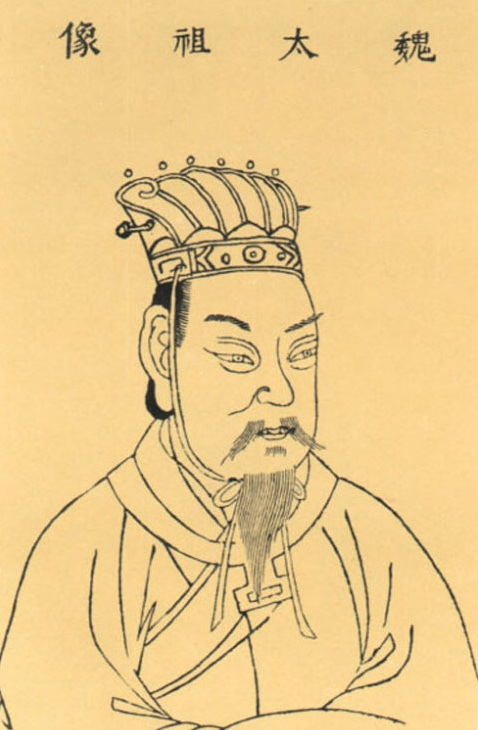 Cao Cao
Cao Cao marches west and fixes the coalition at Tong Pass
Cao Cao leads the central army west to Tong Pass and confronts the coalition head-on across the pass, deliberately drawing and holding the enemy's attention there while he prepares a wider manoeuvre. His subordinates Cao Ren and others hold the eastern approaches under strict orders not to give battle.
 Xu Huang
Xu Huang and Zhu Ling cross the Yellow River at Puban ford
While the coalition watches the pass, Cao Cao sends Xu Huang and Zhu Ling with some 4,000 elite troops north to slip across the Yellow River at Puban ford (near Puzhou, the east-bank crossing by present-day Yongji) and establish a camp on the west bank — turning the coalition's northern flank and opening the way into Guanzhong from behind the pass.
 Xu Chu
Ma Chao's cavalry nearly trap Cao Cao at the north crossing
Cao Cao begins ferrying the main army north across the Yellow River near the great bend. Ma Chao charges the rearguard with thousands of horsemen while Cao Cao is still on the south bank; his bodyguard Xu Chu bundles him aboard a boat and fends off arrows with a saddle, and the officer Ding Fei releases army cattle and horses, whose scattering tempts the attackers to break off and plunder. Cao Cao escapes downstream, remarking he was 'almost trapped by that little scoundrel today.'
Cao CaoCao Cao crosses the Wei and raises the frozen ramparts
Reunited on the west bank, Cao Cao advances south and bridges the Wei River to plant a camp on its southern bank, deep in coalition ground. Cavalry raids keep collapsing his works in the loose sand, so — on Lou Gui's advice — his men reportedly pile sand and pour water over it, letting the cold night freeze it into solid walls by dawn, securing the bridgehead. (Historians doubt the season was cold enough; the tale may be embellished.)
 Han Sui
Cao Cao and Han Sui talk of old times, not war
On Jia Xu's counsel, Cao Cao feigns willingness to make peace. He meets Han Sui — an old acquaintance whose father was a colleague of Cao Cao's — between the lines, and the two chat only of capital affairs and former days, avoiding any military matter, in full view of both armies. When Han Sui returns, Ma Chao presses him on what was said; his vague answer plants the first seed of suspicion.
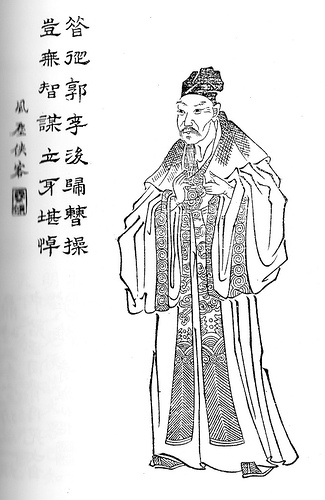 Jia Xu
The doctored letter turns Ma Chao against Han Sui
Cao Cao and his strategist Jia Xu complete the ruse: Cao Cao sends Han Sui a letter deliberately smudged and amended in places, as if Han Sui himself had edited it to hide its contents. When Ma Chao sees it, the tampering seems proof that Han Sui is negotiating secretly behind his back, and the coalition's joint command fractures into mutual suspicion.
Cao CaoThe cavalry strike shatters the coalition
With the coalition divided, Cao Cao attacks. Light troops open the fight and fix the enemy in place; then his elite cavalry strikes from both flanks in a pincer. The Guanzhong army breaks catastrophically — Cheng Yi and Li Kan are killed, Yang Qiu flees toward Anding, and Ma Chao and Han Sui retreat west to Liang Province. Cao Cao masters Guanzhong.
Phase by phase
- Coalition musters at the pass · c. 3rd month (spring) 211 CEMa ChaoThe Guanzhong warlords rise and seize Tong PassGuanzhong Coalition (Ma Chao & Han Sui)Alarmed that Cao Cao's order for Zhong Yao to march through Guanzhong against Zhang Lu is really aimed at them, some ten western warlords led by Ma Chao and Han Sui rebel and concentrate their armies at Tong Pass, the fortified gateway between the Qinling mountains and the Yellow River bend that guards the road into the Wei valley and Chang'an.Tong Pass (Tongguan), south of the Wei–Yellow confluence, Shaanxi · reconstructed · Sanguozhi (Wudi ji; Ma Chao biography) via Wikipedia: Battle of Tong Pass (211); Wikipedia: Tong Pass (coordinates, geography)
- Cao Cao advances and pins the pass · c. 7th month 211 CECao CaoCao Cao marches west and fixes the coalition at Tong PassCao CaoCao Cao leads the central army west to Tong Pass and confronts the coalition head-on across the pass, deliberately drawing and holding the enemy's attention there while he prepares a wider manoeuvre. His subordinates Cao Ren and others hold the eastern approaches under strict orders not to give battle.Eastern approaches to Tong Pass · reconstructed · Sanguozhi (Wudi ji) via Wikipedia: Battle of Tong Pass (211)
- Secret outflanking crossing · c. 8th month 211 CEXu HuangXu Huang and Zhu Ling cross the Yellow River at Puban fordCao CaoWhile the coalition watches the pass, Cao Cao sends Xu Huang and Zhu Ling with some 4,000 elite troops north to slip across the Yellow River at Puban ford (near Puzhou, the east-bank crossing by present-day Yongji) and establish a camp on the west bank — turning the coalition's northern flank and opening the way into Guanzhong from behind the pass.Puban ford (蒲阪津), Yellow River near Puzhou (present-day Yongji, Shanxi) · reconstructed · Sanguozhi (Xu Huang biography) via Wikipedia: Battle of Tong Pass (211) and Liquisearch; Puban/Puzhou ford location per Yuncheng gov / Britannica 'Puzhou'
- Ambush at the Yellow River crossing · c. 8th month 211 CEXu ChuMa Chao's cavalry nearly trap Cao Cao at the north crossingCao Cao begins ferrying the main army north across the Yellow River near the great bend. Ma Chao charges the rearguard with thousands of horsemen while Cao Cao is still on the south bank; his bodyguard Xu Chu bundles him aboard a boat and fends off arrows with a saddle, and the officer Ding Fei releases army cattle and horses, whose scattering tempts the attackers to break off and plunder. Cao Cao escapes downstream, remarking he was 'almost trapped by that little scoundrel today.'Yellow River crossing near the Wei confluence and river bend, north of Tong Pass · reconstructed · Sanguozhi (Xu Chu biography; Wudi ji) via Wikipedia: Battle of Tong Pass (211) and Liquisearch
- West-bank advance and Wei River crossing · c. 8th–9th month 211 CECao CaoCao Cao crosses the Wei and raises the frozen rampartsCao CaoReunited on the west bank, Cao Cao advances south and bridges the Wei River to plant a camp on its southern bank, deep in coalition ground. Cavalry raids keep collapsing his works in the loose sand, so — on Lou Gui's advice — his men reportedly pile sand and pour water over it, letting the cold night freeze it into solid walls by dawn, securing the bridgehead. (Historians doubt the season was cold enough; the tale may be embellished.)West bank of the Yellow River and south bank of the Wei River · reconstructed · Sanguozhi (Wudi ji; Lou Gui) via Wikipedia: Battle of Tong Pass (211) and Liquisearch; freezing-ramparts detail flagged as disputed
- Feigned alliance and parley · c. 9th month 211 CEHan SuiCao Cao and Han Sui talk of old times, not warOn Jia Xu's counsel, Cao Cao feigns willingness to make peace. He meets Han Sui — an old acquaintance whose father was a colleague of Cao Cao's — between the lines, and the two chat only of capital affairs and former days, avoiding any military matter, in full view of both armies. When Han Sui returns, Ma Chao presses him on what was said; his vague answer plants the first seed of suspicion.Ground between the armies on the Wei River south bank (Weinan area) · reconstructed · Sanguozhi (Jia Xu biography; Wudi ji) via Wikipedia: Battle of Tong Pass (211)
- The altered letter sows distrust · c. 9th month 211 CEJia XuThe doctored letter turns Ma Chao against Han SuiCao CaoCao Cao and his strategist Jia Xu complete the ruse: Cao Cao sends Han Sui a letter deliberately smudged and amended in places, as if Han Sui himself had edited it to hide its contents. When Ma Chao sees it, the tampering seems proof that Han Sui is negotiating secretly behind his back, and the coalition's joint command fractures into mutual suspicion.Coalition camp, Wei River south bank (Weinan area) · reconstructed · Sanguozhi (Jia Xu biography; Wudi ji) via Wikipedia: Battle of Tong Pass (211)
- Decisive battle and collapse · c. 9th month 211 CECao CaoThe cavalry strike shatters the coalitionWith the coalition divided, Cao Cao attacks. Light troops open the fight and fix the enemy in place; then his elite cavalry strikes from both flanks in a pincer. The Guanzhong army breaks catastrophically — Cheng Yi and Li Kan are killed, Yang Qiu flees toward Anding, and Ma Chao and Han Sui retreat west to Liang Province. Cao Cao masters Guanzhong.Wei River south bank near Weinan; coalition flight westward toward Liang Province / Anding · reconstructed · Sanguozhi (Wudi ji; Ma Chao biography) via Wikipedia: Battle of Tong Pass (211) and Liquisearch
Sources
- Chen Shou, Records of the Three Kingdoms (Sanguozhi), Book of Wei — Biography of Cao Cao (Wudi ji) and biographies of Ma Chao, Xu Huang, Xu Chu, Jia Xu; via Wikipedia
- Wikipedia: Battle of Tong Pass (211) — https://en.wikipedia.org/wiki/Battle_of_Tong_Pass_(211)
- Wikipedia: Tong Pass — https://en.wikipedia.org/wiki/Tong_Pass (coordinates 34.606N 110.286E; south of the Wei–Yellow confluence)
- Liquisearch: Battle of Tong Pass (211) — The Battle — https://www.liquisearch.com/battle_of_tong_pass_211/the_battle
- Historical geography of Puban/Puzhou ford (蒲阪津), east bank of the Yellow River near present-day Yongji, Shanxi — Yuncheng municipal government / Britannica 'Puzhou'
On the data
This is an ancient battle known almost entirely from a single narrative tradition (Chen Shou's Sanguozhi and Pei Songzhi's commentary), so nearly every troop movement is RECONSTRUCTED, not independently documented; no contemporaneous maps or orders of battle survive. Only the campaign's broad outline (confrontation at Tong Pass, the Yellow-then-Wei river crossings, the feigned-alliance/altered-letter ruse, the cavalry victory) is firmly attested; exact routes, dates within 211, and the precise crossing points are inferred. Phase coordinates are plausible reconstructions anchored to the real Tong Pass site (≈110.24,34.54 / Wikipedia's 110.286,34.606) and to the historically located Puban/Puzhou ford to the north; they are NOT surveyed positions. The famous overnight sand-and-ice ramparts (Lou Gui's stratagem) are recorded but doubted by historians, who question whether early-autumn temperatures could freeze water — treat as legendary-tinged. Han Sui's portrait is a much later Qing-dynasty illustration, and the Ma Chao / Xu Huang / Xu Chu / Jia Xu images are likewise later artistic depictions, not contemporary likenesses. This account deliberately follows the Sanguozhi history and excludes the embellished single-combat duels and dramatized dialogue of the later novel Romance of the Three Kingdoms.
Hand-authored from the sources below. Spotted a mistake? Email [email protected].